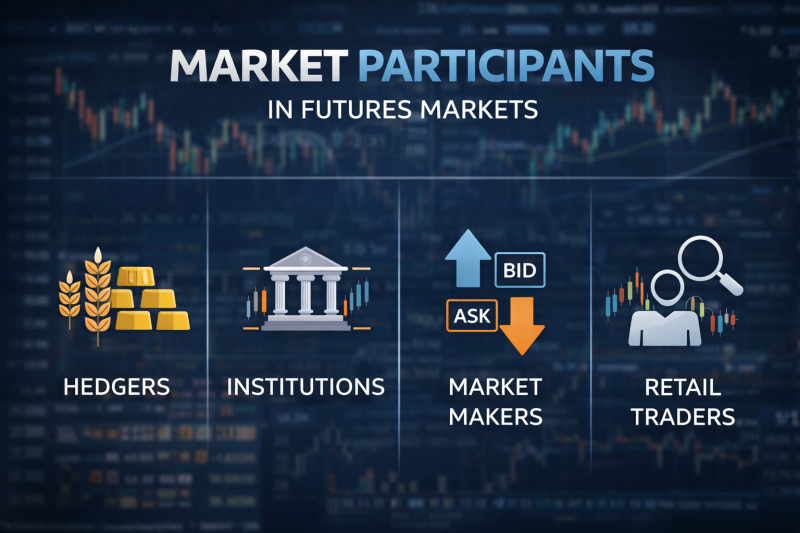
Market Participants
Introduction
Futures markets are driven by different types of participants, each with distinct goals, constraints, and behaviors.
Understanding who is active in the market helps traders interpret price movement more objectively.
Markets do not move randomly — they move because participants act for specific reasons.
Main Types of Market Participants
Hedgers
Hedgers use futures to reduce business risk, not to speculate.
Examples:
-
Farmers hedging crop prices
-
Energy companies hedging fuel costs
-
Corporations managing interest rate or currency exposure
Their primary goal is price stability, not profit maximization.
Institutional Traders
Institutions include:
-
Banks
-
Asset managers
-
Hedge funds
They trade futures for:
-
Portfolio hedging
-
Exposure management
-
Tactical positioning
Institutional activity often influences market structure, volatility, and liquidity.
Market Makers
Market makers provide liquidity by continuously quoting bid and ask prices.
Their role:
-
Facilitate trading
-
Reduce spreads
-
Maintain orderly markets
They do not trade based on directional bias but on order flow and inventory management.
Retail Traders
Retail traders seek opportunity and profit.
Characteristics:
-
Smaller position sizes
-
Higher sensitivity to volatility
-
Often influenced by emotions
Retail participation increases activity but rarely controls long-term direction.
Why This Matters
Price behavior changes depending on which participants are active.
Understanding participation helps traders avoid false assumptions about market intent.